
Harrison County City Directory Collections
The richest shelf for directory work sits in Biloxi. The Harrison County Library System directory collection is housed at Biloxi Public Library's Local History & Genealogy Department. There is no single county-wide book. Instead, the Harrison County volumes come as separate Biloxi, Gulfport, Coast-wide, telephone, and reverse directories. That shape matters for any resident lookup. A family living just outside Biloxi may show up in a Coast Cities volume. A Biloxi book alone might miss them. A Gulfport address from the later years might appear only in a Polk run. Check the catalog for the exact issues held. Note the place and year before assuming a name is truly missing from the residents directory.
| Collection | Years | Where Held | Access |
|---|---|---|---|
| Gulf Coast Business Directory | 1904 | Biloxi Local History & Genealogy | Consult the local collection |
| Biloxi directory volumes | 1905; 1913-14; 1922-23; 1931; 1936; 1940-41; 1958; 1972-83; 1985-86; 1988-92 | HCLS shelves | In person or research request |
| Gulfport directory volumes | 1985-90; 1992-93 | HCLS shelves | In person or research request |
| Mississippi Coast Cross Reference Directory | 1986-95; 1997; 2000-01; 2004 | HCLS | Address-to-name checking, coverage to confirm |
| Mississippi Gulf Coast Polk directory | 2003-06 | HCLS | Regional volume consultation |
Gaps tell their own story. The Harrison County series changed publishers over time. No city was guaranteed an issue every year. Some years simply produced no street directory at all. The Library System also holds a 1950-51 Mississippi Coast Telephone Directory and a 1951 Keesler AFB Telephone Directory. Each works only inside its stated scope. A name absent from one volume could mean a collection gap. It could also mean an unlisted number, a move, or a different community label in the city directory.
Note: Record the volume title and issue year. A Coast-wide directory is not the same evidence as a Biloxi-only listing.
Harrison County Historical Directory Access
The Local History & Genealogy Department at Biloxi Public Library takes research requests several ways. You can ask in person, by phone, email, or mail. Call ahead before a specialized visit. The department has a single microfilm and microfiche reader-printer, a nominal copy charge, and a one-hour limit whenever another reader is waiting. Hours and contact details appear through the Harrison County Library System. Library computers open selected research databases. Some of those require an HCLS card for remote use.
Start with the library's own directory list before requesting a reel. It names each publisher and the exact run of years. That helps separate a true collection gap from a simple search error. The directory shelf sits beside cemetery cards, funeral indexes, newspapers, and local-history files. One visit can test a resident lookup lead several ways. No single book should be treated as complete.
See the library's directory list before making a request. It documents the local volumes and their year runs.
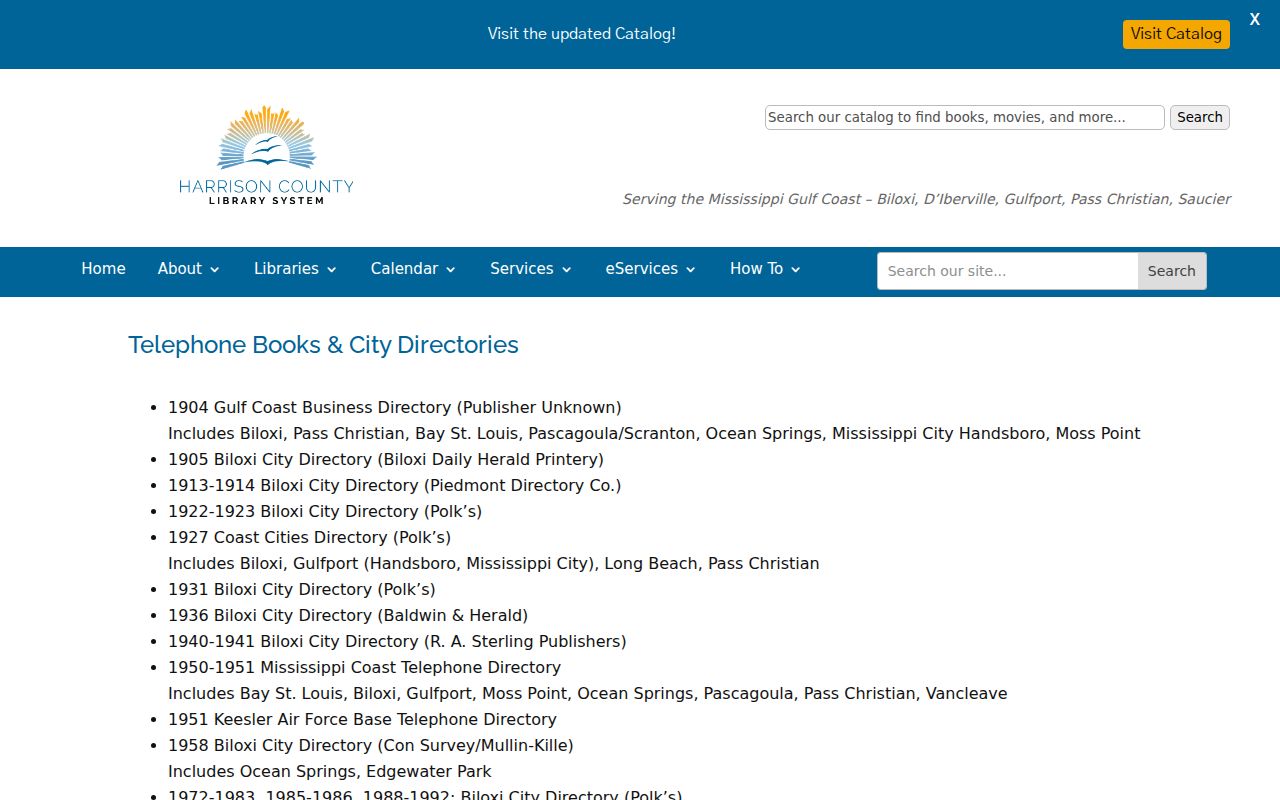
The library's collection list explains why a year-by-year check matters. Harrison County historical directories form a set of separate local and regional issues, not one continuous online roll of past residents.
Harrison County Directory Runs by Publisher
The earliest directory work on the Coast starts with the 1904 Gulf Coast Business Directory and a 1905 Biloxi volume printed by the Biloxi Daily Herald Printery. From there, HCLS holds a clear publisher sequence. Piedmont Directory Company covered 1913-14, Polk issued volumes for 1922-23 and 1931, Baldwin & Herald printed 1936, and R.A. Sterling Publishers handled 1940-41. The 1927 Polk Coast Cities Directory is a standout. It reaches Biloxi, Gulfport, Handsboro, Mississippi City, Long Beach, and Pass Christian, which makes it especially useful when an old address sits near a community line that has since shifted. Neighbors and past residents of Harrison County often turn up in these coastal volumes before any countywide record does.
Later Polk series cover Biloxi in stretches from 1972 through 1992, with Gulfport runs in the late 1980s and early 1990s. A 1958 Biloxi directory also reaches Ocean Springs and Edgewater Park. Those overlapping geographies can trace a move along the Coast. Just do not mistake them for countywide coverage of Harrison County.
| 1904 | Gulf Coast Business Directory opens the documented Coast-wide shelf. |
|---|---|
| 1905 | Biloxi's local directory sequence begins in the documented holdings. |
| 1927 | Polk's Coast Cities Directory brings several Harrison communities into one volume. |
| 2003-06 | Mississippi Gulf Coast Polk volumes provide the documented later regional run. |
Note: No authoritative source gives a final printed year for every local directory series, so treat 2006 as a documented regional holding rather than a universal ending date.
Reading a Harrison County City Directory Entry
A directory entry is an index line, not a biography. Look for an alphabetical name heading first. The local text sources point to a handful of fields the actual volumes carry: a household relationship where the publisher supplied one, an occupation or business line, a street address, a telephone number in telephone books, and cross-references to other listings. Some issues lean on symbols for ownership, widow status, or residence. Publishers varied their marks, though. Read the book's own abbreviation key before assigning any meaning to a mark.
| Name heading | Usually a surname followed by a given name or initial. |
|---|---|
| Household clue | A spouse or relationship may appear when the publisher included it. |
| Address | Street name and number, apartment, or unit when supplied. |
| Line detail | An occupation, business, telephone, institution, or alternate-spelling reference may appear. |
| Notation | Use the volume key for any residence, ownership, widow, or street abbreviation. |
- Criss-cross directory
- A reverse section arranged by street address, used to locate a listed name from a known address.
- Householder index
- An index that points to the main household listing, rather than proving every person at that address.
- Abbreviation key
- The legend in the volume that defines its street, telephone, and residence shorthand.
The text sources for Harrison County print no rendered sample entry. Expand no abbreviation from memory, and assume no notation carries over from one publisher's volume to the next.
Harrison County Reverse Address Volumes
The Mississippi Coast Cross Reference Directory works like a surname index turned inside out. Instead of starting with a name, you start with a street. The Harrison County Library System holds issues from 1986 through 1995. It also holds 1997, 2000, 2001, and 2004. A single reverse entry can carry a listed name, a telephone clue, or the address itself. It may also carry a business reference for that year's volume. Coverage shifts from one edition to the next. Read the front matter before trusting any absence.
Search with the printed street spelling and house number first. Miss, and the old community label may still rescue you. Try a road-name variant or the legal description from the parcel record. Mississippi City and Handsboro both survive as search terms. They still work even when a modern lookup says Gulfport. Keep modern parcel questions with the by-address records. Leave the historical digging to these local volumes.
Harrison County Directory Archive Context
Nineteenth-century work calls for a second archive. The Mississippi Department of Archives and History Harrison County finding aid belongs beside the library shelf. MDAH lists Harrison County record series running from 1870 to 1979. Broader county-record series reach back to 1799 and forward to 1980. Series 1202 digitizes selected Harrison land and personal assessments. These cover 1842 through 1899. An assessment can tie a name or a legal description to an earlier property context, though it is not an address book. Still, it is not an address book. It offers no yearly household list. Plan on catalog searching, reading-room originals, and microfilm in the media room. The catalog stretches well past government records. It holds maps, newspapers, oral histories, yearbooks, cemetery references, and genealogical files. That breadth makes MDAH a strong fallback whenever an HCLS volume has a gap. It also serves a surname needing a second source. The MDAH Harrison holdings describe each archival series and how to reach it.
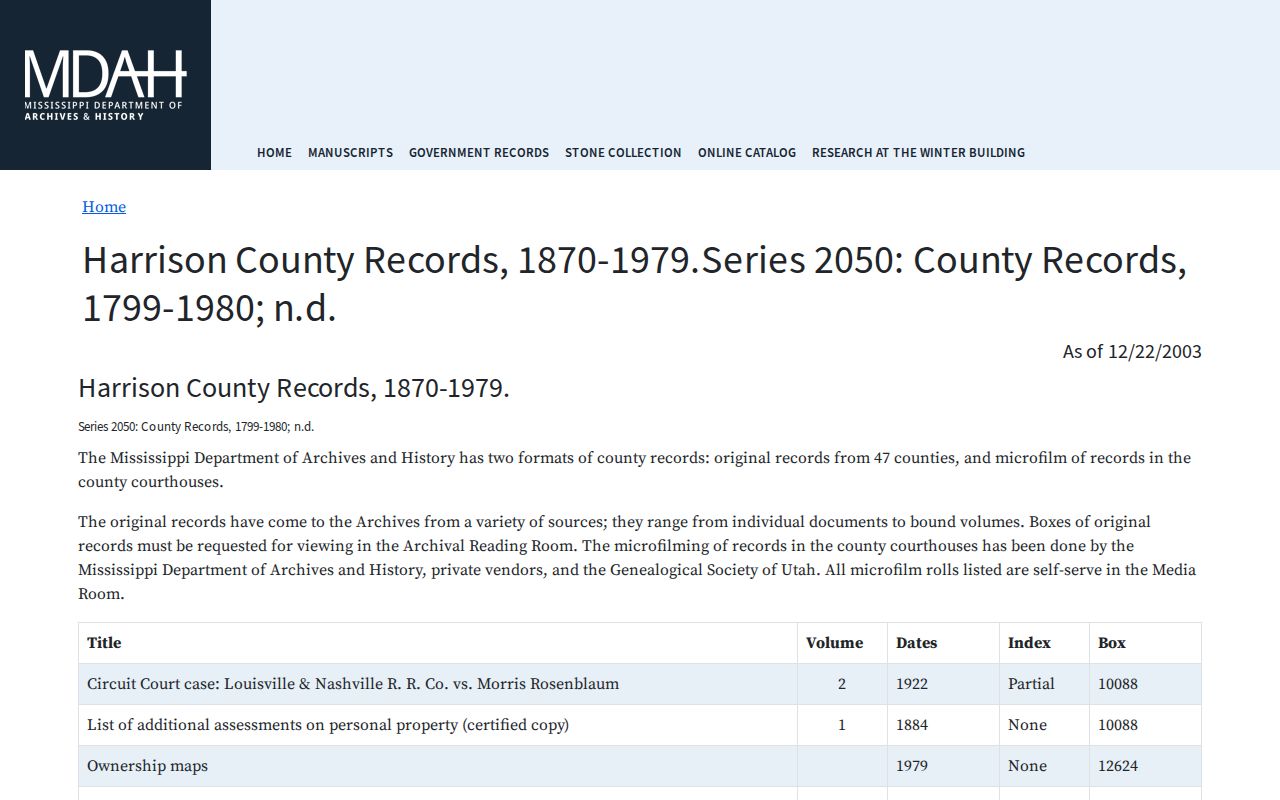
When a local shelf starts later than the period under investigation, MDAH adds an earlier records layer to the Harrison County directory search.
Harrison County Digital Directory Leads
Start discovery at the Mississippi Digital Library gateway. It is a doorway into digitized local historical material. HCLS also steers researchers toward its digital archive, Sanborn maps, WPA County Files, oral histories, cemetery resources, and historical societies. Another route is FamilySearch's city and business directory collection. It searches by person, occupation, and address where an item is indexed. Image access varies by item. Treat all of these as discovery paths. None proves that every Harrison directory has been digitized. Search Biloxi, Gulfport, Long Beach, Pass Christian, and Harrison County separately. The Coast appears in records under shifting city and community names. So a wide search can surface items a modern city-only query misses. For newspapers, HCLS holds Daily Herald microfilm beginning in 1888. There is a gap from March 1964 through August 1965. The Mississippi Digital Library folds digitized collection discovery into the same research chain.
A catalog hit is only a lead to inspect; many local volumes and reels still travel through the library and the archive.
Trace Harrison County Directory Households
Before deciding a household moved, trace it through at least two issues. Begin with the earliest known name or address. Copy the exact line and the abbreviation key. Then check the next available volume instead of assuming an annual sequence. Gaps in the shelf are common. Pair each directory year with the nearest federal census. It is released after 72 years and is open through 1950. Census entries help separate people who share a surname. They also show a household at a wider interval than any single directory can.
- Find the person or address in the earliest available local volume and copy the title, date, page, spelling, and street detail.
- Check the next available Harrison County directory issue, noting only changes that the two editions actually show.
- Use a cross-reference volume when one covers the address and year, then compare the result with the name listing.
- Pair the nearest available census with the directory evidence, using household relationships and geography to separate same-name people.
- Use a dated newspaper notice, funeral index, cemetery card, deed, or probate file to test a move, death, or inheritance lead.
A disappearance carries no single meaning. The person may have moved, died, or changed a name. They may have lived under another community label. They may simply have been left out of that issue. HCLS offers two useful next checks. One is the Bradford-O'Keefe Funeral Records index covering 1901 through 1960. The other is the library's cemetery card lists. Note: A directory supplies a dated lead, and a census, clerk record, or custodian-held document tests that lead independently.
Harrison County Directory Preservation Story
Older Harrison research works partly because local records were saved on purpose. Harrison County joined the state's Local Government Records program in 1996. It was the first county in Mississippi to do so. Older records came under retention schedules. During 2001 and 2002, Genealogical Society of Utah volunteers microfilmed older chancery, land, voter-registration, and marriage material. The effort earned the Mississippi Historical Society's 2001 James T. Dawson Award. The Biloxi local-history and genealogy center also returned downtown after a temporary Hurricane Katrina move. A 2008 city notice described period photographs, local volumes, and cemetery records in the returning collection. Daily Herald and Sun Herald microfilm were included as well. This preservation history explains a practical truth. A Harrison County historical-directory search may shift among a local shelf, microfilm, an archive catalog, and a digital gateway rather than one database.